
Tank Fabrication in Nigeria
Nigeria’s oil and gas terminals, water utilities, factories, and even individual households all depend on the same underlying capability: tanks that can hold diesel, LPG, crude oil, potable water, or industrial chemicals safely for decades in a hot, humid, and often corrosive environment. Tank fabrication in Nigeria has grown from an import-dependent afterthought into a mature local industry, shaped by strict government local-content rules, a chronic reliance on backup power and water storage, and a fast-growing oil and gas midstream sector.
This guide breaks down everything a buyer, engineer, or project manager needs to know about Nigeria tank fabrication: the types of tanks built locally, the materials and welding standards involved, the step-by-step fabrication process, the regulators that govern the industry, and a practical checklist for choosing a fabricator.
Quick answer: Tank fabrication in Nigeria is the engineering, welding, and installation of custom steel (or GRP) tanks for storing liquids and gases — water, diesel, LPG, crude oil, or chemicals — built to codes such as API 650 and API 620, certified against Standards Organisation of Nigeria (SON) requirements, and regulated by NMDPRA for midstream and downstream petroleum storage.
Table of Contents
- What Is Tank Fabrication?
- Types of Tanks Fabricated in Nigeria
- Materials Used in Nigerian Tank Fabrication
- The Tank Fabrication Process, Step by Step
- Standards and Regulatory Compliance in Nigeria
- Why Local Content Matters
- Key Industries That Rely on Tank Fabrication
- How to Choose a Tank Fabrication Company in Nigeria
- What Affects the Cost of Tank Fabrication
- Frequently Asked Questions
What Is Tank Fabrication?
Tank fabrication is the branch of heavy structural steelwork that turns flat steel plate — or, less commonly, stainless steel, aluminium, or GRP/fibreglass sheet — into a finished storage vessel. It sits at the intersection of engineering design, pressure-vessel code compliance, and precision welding, and it’s distinct from mass-produced tank manufacturing: the moulded plastic or polyethylene tanks sold off the shelf in hardware stores.
A fabricated tank is engineered for one specific job: a defined capacity, a defined product (crude oil, diesel, LPG, potable water, effluent), a defined site, and a defined design code. That’s why virtually all large-scale industrial, oil and gas, and municipal water storage in Nigeria — as opposed to small household water tanks — is custom fabricated rather than bought ready-made.
Types of Tanks Fabricated in Nigeria
Above-Ground Storage Tanks (ASTs)
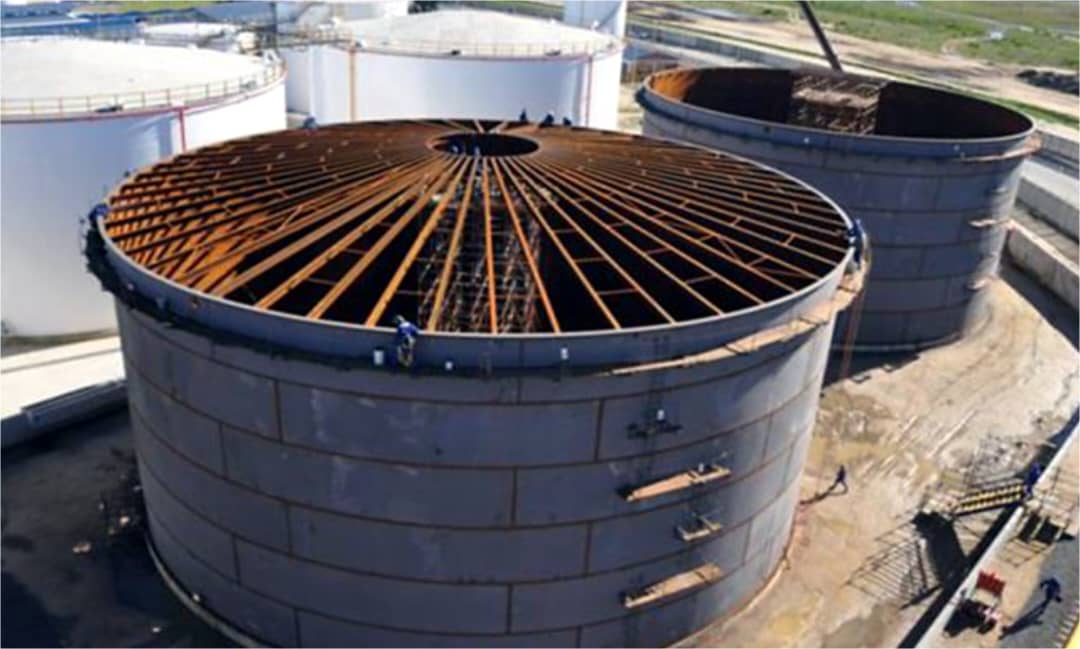
The workhorse of Nigeria’s tank farms and depots. Cylindrical, vertical, flat- or cone-bottomed tanks store crude oil, refined petroleum products, and chemicals at depots, refineries, and marketing terminals across Lagos, Port Harcourt, Warri, and Calabar. Built to API 650 with fixed or floating roofs, depending on the product’s volatility.
Underground Storage Tanks (USTs)
Common at filling stations, where petrol and diesel are stored below grade for safety and space reasons. USTs need extra corrosion protection — coatings, cathodic protection, or double-wall construction — because they sit in constant contact with soil and, in coastal areas, a high water table.
LPG and Pressurised Gas Tanks
Spherical or bullet-shaped pressure vessels for storing Liquefied Petroleum Gas at a design pressure well above atmospheric. Demand has grown quickly alongside Nigeria’s LPG (cooking gas) penetration drive, from small skid-mounted plants to large bulk-storage spheres at import terminals.
Water Storage Tanks
Elevated and ground-level steel tanks for boreholes, estate water schemes, hotels, factories, and hospitals. Given Nigeria’s inconsistent public water supply, private water storage — usually paired with a borehole and pumping system — is one of the most common tank fabrication jobs outside the oil and gas sector.
Chemical and Process Tanks
Lined or stainless-steel tanks for corrosive or reactive substances used in manufacturing, water treatment, and industrial processing, including pretreatment tanks for galvanising and surface-coating plants.
Fire Water Tanks
Dedicated tanks holding a guaranteed reserve of water for fire-suppression systems at industrial and oil and gas facilities — often a fixed requirement for HSE compliance and insurance.
Septic, Effluent, and Waste Tanks
Tanks for sewage treatment plants, effluent holding, and waste storage on industrial and residential sites.
Pressure Vessels and Skid-Mounted Tanks
Compact, pre-assembled tank-and-equipment packages — separators, knockout drums, mobile LPG skids — fabricated in a shop and transported to site as a single unit.
Materials Used in Nigerian Tank Fabrication
Carbon Steel and Mild Steel
The default material for large atmospheric and low-pressure tanks, thanks to its strength-to-cost ratio. It’s almost always paired with a coating system — typically sandblasting to a specified surface profile, followed by an epoxy or polyurethane paint system — because unprotected carbon steel corrodes quickly in Nigeria’s humid, salt-laden coastal air.
Stainless Steel (Grades 304 and 316)
Used where hygiene or corrosion resistance matters more than cost: food and beverage processing, pharmaceuticals, some potable-water applications, and chemical storage. 316-grade stainless, with its added molybdenum, is preferred in coastal and offshore settings for its resistance to chloride pitting.
GRP/Fibreglass and HDPE
Glass-reinforced plastic and high-density polyethylene are increasingly used for smaller water and chemical tanks. They don’t corrode, weigh far less than steel, and need no painting — the trade-offs are a lower practical maximum size and less resistance to high temperatures and mechanical impact compared with steel.
The Tank Fabrication Process, Step by Step
- Site survey and consultation. The fabricator assesses ground conditions, product type, capacity requirements, access for delivery or field welding, and any client-specific standards before quoting.
- Engineering design. Structural engineers calculate plate thickness, wind and seismic loading, foundation requirements, and nozzle placement, producing fabrication drawings for approval.
- Material procurement and mill certification. Steel plate is sourced with mill test certificates confirming grade and chemical composition — a requirement for API- and SON-compliant work.
- Plate cutting, rolling, and forming. Plates are cut to size and rolled into cylindrical shell courses, or pressed and formed for dished heads and roof plates.
- Welding. Shell courses, roof, and floor are welded using qualified procedures — commonly SMAW or submerged-arc welding for larger tanks — either in a fabrication shop for smaller tanks or field-erected plate by plate on site for large tank farms.
- Non-destructive testing (NDT). Welds are checked by radiography, ultrasonic testing, or dye-penetrant inspection to confirm they meet code before the tank enters service.
- Hydrostatic or pneumatic testing. The finished tank is filled with water (or pressurised with air, for pressure vessels) to confirm it holds without leaks or deformation.
- Surface preparation and coating. Sandblasting to the specified profile, followed by a primer and top-coat system suited to the stored product and the site’s exposure to humidity and salt.
- Installation, erection, and commissioning. Foundation tie-in, ancillary fittings (vents, gauges, manways, ladders), final inspection, and handover documentation.
Standards and Regulatory Compliance in Nigeria
Tank fabrication in Nigeria sits under several overlapping design codes and regulatory bodies. A reputable fabricator should be explicit about which of these apply to your project:
- API 650 — Welded Steel Tanks for Oil Storage. The most widely used design code for atmospheric, above-ground storage tanks in Nigeria’s oil and gas sector.
- API 620 — Design and Construction of Large, Welded, Low-Pressure Storage Tanks. Used for tanks operating slightly above atmospheric pressure, including some LPG and refrigerated storage.
- API 653 — Tank Inspection, Repair, Alteration, and Reconstruction. Governs in-service inspection and repair once a tank is operational.
- Standards Organisation of Nigeria (SON). Nigeria’s national standards body; SON conformity assessment is required for many manufactured and fabricated products sold in Nigeria.
- NMDPRA (Nigerian Midstream and Downstream Petroleum Regulatory Authority). Established under the Petroleum Industry Act 2021 from the merger of the former DPR’s midstream/downstream division, PPPRA, and PEFMB, NMDPRA licenses and regulates the storage, distribution, and depot infrastructure that most tank fabrication ultimately serves. Depot and filling-station tank installations typically require NMDPRA approval.
- NUPRC (Nigerian Upstream Petroleum Regulatory Commission). Regulates upstream facilities — flow stations, well-head tanks — where fabrication is part of an exploration or production asset.
- NESREA (National Environmental Standards and Regulations Enforcement Agency). Enforces environmental compliance, including secondary containment (bunding) and spill-prevention design around storage tanks.
- COREN (Council for the Regulation of Engineering in Nigeria). Tank design should be signed off by a COREN-registered engineer — both a legal requirement for engineering practice in Nigeria and a useful due-diligence check on a fabricator’s credentials.
Together, these mean a tank built for a Nigerian oil and gas client is rarely judged on welding quality alone. Documentation — mill certificates, NDT reports, hydrotest records, and regulatory approvals — matters just as much as the physical tank.
Why Local Content Matters
Nigeria’s local content law gives tank fabrication particular weight in the oil and gas sector. Under the Nigerian Oil and Gas Industry Content Development (NOGICD) Act 2010, enforced by the Nigerian Content Development and Monitoring Board (NCDMB), operators must prioritise Nigerian fabrication capacity — and fabrication and welding are among the activities targeted for 100% local content. Every oil and gas project must submit a Nigerian Content Plan, and contractors generally need to be registered on the Nigerian Oil and Gas Industry Content Joint Qualification System (NOGIC JQS) and hold a valid NCDF (Nigerian Content Development Fund) compliance certificate to bid competitively.
As of 2026, overall local participation across Nigeria’s oil and gas industry has reached roughly 61%, with the NCDMB targeting 70% by 2027 — a policy direction that keeps pushing fabrication work toward Nigerian yards rather than imported, pre-built tanks. Beyond compliance, local fabrication typically means faster turnaround, no import duty or forex exposure on the finished tank, easier access for repairs and modification, and a fabricator who understands Nigerian site conditions, from Lagos’s coastal humidity to the harmattan dust further north.
Key Industries That Rely on Tank Fabrication
- Oil and gas — tank farms, depots, flow stations, and export terminals across the Niger Delta, Lagos, and the wider product-distribution network.
- Water utilities and real estate — boreholes, estate water schemes, and commercial buildings, driven by inconsistent public water supply.
- Power and backup generation — diesel storage tanks sized to keep generators running through extended grid outages.
- Agriculture and agro-processing — irrigation storage and process tanks for processing plants.
- Manufacturing, FMCG, and food and beverage — stainless process tanks and hygienic storage.
- Hospitality — hotels and resorts needing independent water storage.
- Surface treatment and galvanising — pretreatment, pickling, and rinsing tanks for coating plants near industrial clusters such as Ikeja, Apapa, and the Lekki Free Trade Zone.
How to Choose a Tank Fabrication Company in Nigeria
Not every fabricator is equipped for every job. Before awarding a contract, check for:
- A verifiable project history. Ask for a project list or gallery and, where possible, speak to a past client with a similar tank type and capacity.
- Relevant certification. SON registration, API-compliant design capability, ISO 9001 quality management, and COREN-registered engineering sign-off.
- In-house design and engineering. Fabricators who calculate and draw in-house, rather than outsourcing design, tend to move faster and take fuller responsibility for the finished product.
- Documented quality control. Ask what NDT methods they use, whether hydrostatic testing is standard, and whether you’ll receive full documentation — mill certs, weld maps, test reports — at handover.
- NOGIC JQS registration and NCDF compliance, if the work is for an oil and gas operator.
- Shop and field capability. Confirm whether your tank will be shop-fabricated and delivered or field-erected on site, and that the fabricator has done both.
- After-sales support. Maintenance, inspection, and repair capability matter over a tank’s 15–25-plus-year service life, not just at handover.
- A clear, itemised quotation that breaks down material, fabrication, coating, testing, and installation rather than a single lump sum.
What Affects the Cost of Tank Fabrication
Because every tank is engineered for a specific job, pricing is quote-based rather than fixed. The main cost drivers are:
- Capacity and dimensions — larger tanks need more plate, more welding, and heavier foundations.
- Material grade — stainless steel and specialised alloys cost significantly more than carbon steel.
- Design complexity — a fixed-roof tank is simpler, and cheaper, than a floating-roof tank or an LPG sphere rated for internal pressure.
- Shop fabrication vs. field erection — field erection adds site mobilisation, scaffolding, and weather-dependent timelines.
- Coating specification — the surface-preparation standard and number of coats required for the operating environment.
- Testing and inspection requirements — full radiographic testing on every weld costs more than spot testing.
- Site conditions — ground preparation, foundation work, and access all vary by location.
- Current steel prices, which move with global commodity markets and the naira exchange rate.
Because of these variables, treat any tank fabrication quote that isn’t backed by a site visit and a drawing with some caution — accurate pricing follows the engineering, not the other way around.
Torch Energy Group — Tank Fabrication Services in Nigeria
This section is a placeholder. Replace it with your company’s specific services, certifications, completed projects, and location(s) before publishing. Search engines and buyers both reward specificity here — real project names (where you have permission to share them), real capacities, real certifications, and a real Nigerian address and phone number will do more for your ranking and conversion rate than generic claims.
Suggested structure for this section:
- One paragraph on your company’s history, location(s), and specialisation.
- A short list of the tank types and capacities you fabricate.
- The certifications and standards you work to.
- Two to four sentences on one to three flagship projects (client name if permitted, tank type, capacity).
- A clear call to action: request a quote, call, or WhatsApp link.
Frequently Asked Questions
What standard is used for tank fabrication in Nigeria?
Most large atmospheric storage tanks in Nigeria’s oil and gas sector are built to API 650, with API 620 used for low-pressure tanks and API 653 governing later inspection and repair. Fabricators must also meet Standards Organisation of Nigeria (SON) requirements, and projects for petroleum depots or filling stations typically require NMDPRA approval.
How long does tank fabrication take in Nigeria?
Timelines depend on size and complexity. A small, shop-fabricated water or chemical tank can be ready in a few weeks; a large, field-erected tank-farm project — including design approval, procurement, and multi-stage welding and testing — commonly takes several months.
What’s the difference between shop-fabricated and field-erected tanks?
Shop-fabricated tanks are built complete, or nearly complete, in a factory and transported to site, which suits smaller tanks and faster delivery. Field-erected tanks are welded plate by plate on site, which is necessary for large tanks too big to transport as a single unit.
Do I need NMDPRA approval for a storage tank in Nigeria?
If the tank stores petroleum products as part of a depot, filling station, or other midstream or downstream facility, it typically falls under NMDPRA’s licensing and technical approval requirements. Tanks that are part of an upstream production facility fall under NUPRC instead. A fabricator experienced in the sector can confirm which approvals your specific project needs.
What’s the best material for a water tank in Nigeria’s climate?
Carbon steel with a proper coating system, stainless steel, and GRP/fibreglass are all used successfully; the right choice depends on budget, required lifespan, and site exposure to humidity and salt air. Coastal installations generally need a higher-grade coating or a more corrosion-resistant material than inland sites.
Is there a local content requirement for tank fabrication in Nigeria’s oil and gas sector?
Yes. Under the NOGICD Act, fabrication and welding are among the activities targeted for 100% local content, and operators must prioritise Nigerian fabrication capacity and submit a Nigerian Content Plan for NCDMB approval.
How much does tank fabrication cost in Nigeria?
Cost depends on capacity, material, design complexity, coating specification, and whether the tank is shop-fabricated or field-erected, so it’s quoted per project rather than at a fixed rate. A fabricator should give you an itemised quote after reviewing your requirements or visiting the site.
Conclusion
Tank fabrication in Nigeria sits at the intersection of heavy engineering, strict design codes, and a regulatory and local-content environment that is unusually well developed for the sector. Whether you need a single water tank for a commercial building or a multi-tank farm for a petroleum depot, the fundamentals stay the same: engineered design, certified materials and welding, documented testing, and compliance with whichever standards — API, SON, NMDPRA, or NUPRC — apply to your project.
Ready to start your tank fabrication project? Contact Torch Energy Group for a site assessment and quotation.