
Pipeline Sectionalization in Nigeria
Nigeria operates one of the most extensive — and most frequently attacked — pipeline networks in Africa. The Nigerian Pipelines and Storage Company (NPSC), a subsidiary of NNPC Limited, alone owns and operates more than 5,000 kilometres of crude oil and petroleum products pipelines linking flow stations, refineries, depots, and export terminals across the country. Pipeline sectionalization — dividing that network into isolated segments with sectionalizing (block) valves — is the single most important engineering strategy for limiting the damage when a section is breached, whether by corrosion, third-party interference, or vandalism.
This guide covers what pipeline sectionalization and sectional pipe repair actually mean, why they matter so much in Nigeria specifically, which standards and regulators govern them, and what to look for when specifying or procuring a sectionalization solution.
What Is Pipeline Sectionalization?
Pipeline sectionalization is the practice of installing valves at planned intervals along a pipeline’s route so the line can be divided into shorter, independently isolable sections. If one section develops a leak, ruptures, or is illegally tapped, operators close the valves on either side of the affected segment and stop the loss without shutting down — or draining — the entire pipeline.
Sectionalizing Valve vs. Block Valve vs. Isolation Valve
These terms get used almost interchangeably in the field, but there are useful distinctions:
- Sectionalizing valve / mainline block valve — a valve on the pipeline’s mainline, at a planned interval, whose main job is dividing the line into sections.
- Isolation valve — the broader category: any valve used to isolate equipment, a station, or a pipe segment from the rest of the system. A sectionalizing valve is one type of isolation valve.
- Emergency shutdown valve (ESDV) — a sectionalizing or block valve that is actuated (motor, hydraulic, or pneumatic) and can close remotely or automatically, usually tied into a SCADA or emergency shutdown system.
“Sectional Replacement” — A Related but Different Meaning
Searches for “pipeline sectional” in Nigeria often point to a second, related but distinct concept: sectional replacement — a repair method where a damaged length of pipe is cut out and replaced with a new section, rather than repairing or replacing the whole line. That’s covered in detail further down.
Why Pipeline Sectionalization Matters So Much in Nigeria
Nigeria’s pipeline network runs through some of the hardest security terrain anywhere — dense mangrove swamps, creeks, and remote farmland across the Niger Delta and the north-central corridor, much of it far from any permanent security presence. That mix of scale, remoteness, and high product value has made vandalism, illegal bunkering, and outright pipeline-material theft a persistent problem, and 2025–2026 has been an active period:
- NNPC Limited has reported that pipeline theft — including criminals stealing physical lengths of pipe, at times posing as government task forces — has risen since 2024. In 2025 alone, the company documented 19 cases resulting in the loss of roughly nine kilometres of pipeline sections along the Enugu–Makurdi–Yola corridor and the Piri–Izom stretch of the Warri–Kaduna route, with five further cases already reported in the first half of 2026 along the Piri–Kwali, Gwagwalada, and Badanga corridors.
- Major trunk lines remain active targets: the Trans Niger Pipeline was attacked near the Odau axis in Rivers State on 15 June 2026, prompting NNPC Limited’s Project Monitoring Office to renew calls for host-community vigilance.
- In response, the Nigerian Upstream Petroleum Regulatory Commission (NUPRC) and the Federal Ministry of Defence launched a joint security framework in mid-2026 pairing long-range drone surveillance with community-focused, “non-kinetic” engagement along pipeline corridors — part of a broader effort that has helped push national crude output back above Nigeria’s OPEC quota, averaging around 1.53 million barrels per day in May 2026.
Well-placed sectionalizing valves are what turn “a breach somewhere on a 600 km pipeline” into “a contained loss on a 15–30 km segment.” They’re a frontline engineering defence that works alongside — not instead of — surveillance, community engagement, and physical security.
The Regulatory and Standards Framework in Nigeria
Anyone specifying, installing, or maintaining sectionalizing valves on a Nigerian pipeline is working within several overlapping frameworks:
- NUPRC (Nigerian Upstream Petroleum Regulatory Commission) regulates upstream pipeline infrastructure — flowlines and trunk lines feeding export terminals.
- NMDPRA (Nigerian Midstream and Downstream Petroleum Regulatory Authority) regulates midstream and downstream pipelines, including products pipelines and depots. Both agencies were carved out of the defunct Department of Petroleum Resources (DPR) under the Petroleum Industry Act (PIA) 2021, and continue to coordinate closely — the two regulators formalised a renewed cooperation agreement, including quarterly joint meetings, in January 2026.
- NCDMB (Nigerian Content Development and Monitoring Board), established under the Nigerian Oil and Gas Industry Content Development (NOGICD) Act 2010, enforces local-content rules, so fabrication, installation, and a meaningful share of valve/materials procurement generally has to involve NCDMB-certified Nigerian companies.
- ASME B31.4 (liquid pipelines) and ASME B31.8 (gas pipelines) are the international design codes governing sectionalizing/block valve placement, spacing, and design pressure.
- API 6D is the standard most commonly referenced for the valves themselves — ball, gate, and plug valves used in pipeline service.
Types of Sectionalizing Valves Used on Nigerian Pipelines
- Ball valves — the most common choice for mainline sectionalizing duty on crude and gas pipelines; full-bore ball valves give a low pressure drop and reliable bubble-tight shutoff.
- Gate valves — still used on some older liquid lines and at tank farms and depots.
- Plug valves — common on smaller-diameter gathering and distribution lines.
- Emergency shutdown valves (ESDVs) — actuated sectionalizing valves that close automatically on a SCADA-detected pressure drop, or remotely on operator command.
- Check valves — often paired with sectionalizing valves on the downstream side of river or creek crossings to stop back-flow if a downstream section is breached.
Most new sectionalizing valve stations on Nigerian projects are now specified with remote SCADA actuation rather than purely manual operation. Manual valves require a technician to physically reach a remote — sometimes insecure — location before a leak can be isolated, which is a real limitation in the swamp and creek terrain typical of the Niger Delta.
Valve Spacing: The Engineering Rules
For gas transmission pipelines, ASME B31.8 sets maximum sectionalizing-valve spacing by “location class” — essentially, how populated the surrounding area is:
| Location Class | Typical Area | Maximum Valve Spacing |
|---|---|---|
| Class 1 | Sparsely populated, rural | 30 km (≈20 miles) |
| Class 2 | Fringe of towns, developing areas | 25 km (≈15 miles) |
| Class 3 | Populated areas near buildings and roads | 15 km (≈10 miles) |
| Class 4 | Dense urban areas, multi-storey buildings | 7 km (≈5 miles) |
Liquid pipelines (crude oil and refined products) under ASME B31.4 don’t follow a fixed distance table. Instead, block valves go at specific risk points: upstream of major river and creek crossings, upstream of public water-supply intakes, at tie-ins and pump/metering stations, and at the edge of populated or environmentally sensitive areas, with a block or check valve on the downstream side too. Offshore segments generally carry no mandatory spacing requirement, since a subsea rupture and an onshore rupture have very different consequences.
In practice, many Nigerian operators specify tighter-than-minimum valve spacing in known high-risk corridors — Niger Delta swamp and creek crossings with a history of illegal tapping — because an extra valve station costs far less than the volume that can be lost, and less than the environmental and reputational cost of a large spill.
Sectional Pipe Repair and Replacement
Separate from sectionalizing valves, “sectional” repair refers to how a damaged length of pipe actually gets fixed once a leak, dent, corrosion patch, or illegal tap is found. Nigerian operators and contractors typically choose between:
- Clamp or sleeve repair — a split sleeve, Type A (non-reinforcing) or Type B (full-strength, welded) sleeve, or a bolt-on repair clamp is fitted over the damaged area. This is faster and usually cheaper, and can often be done without a full shutdown, but it’s generally a temporary or semi-permanent fix depending on sleeve type and damage severity.
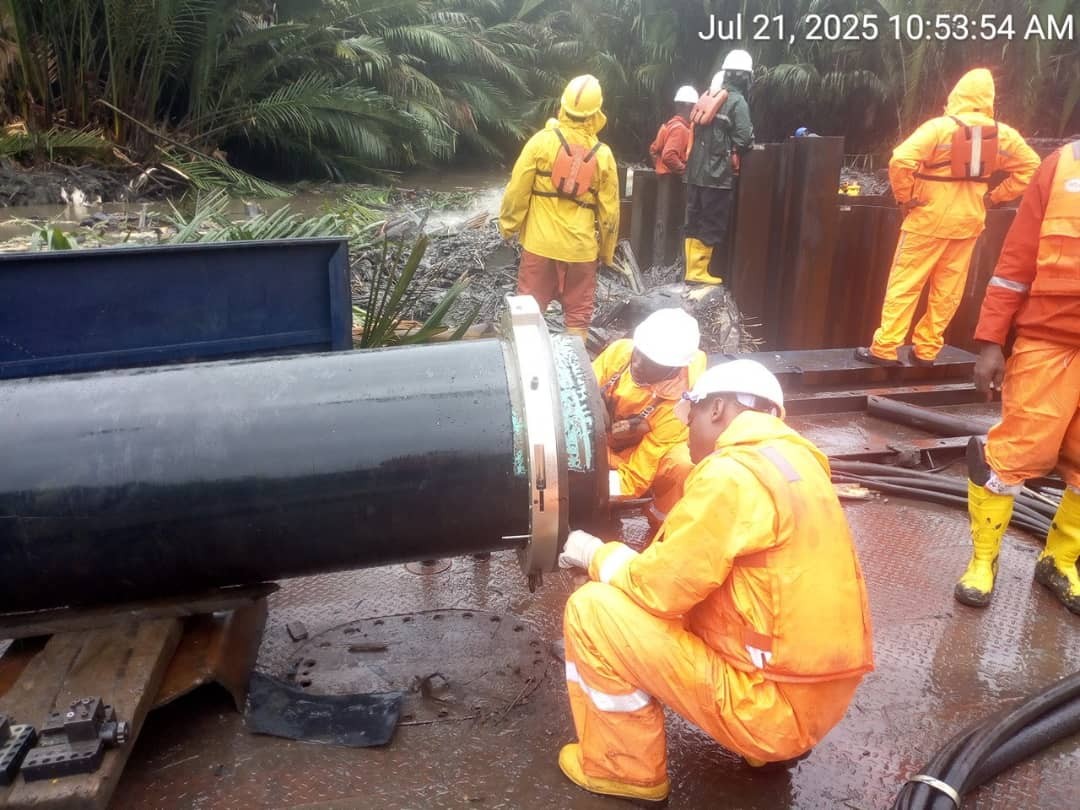
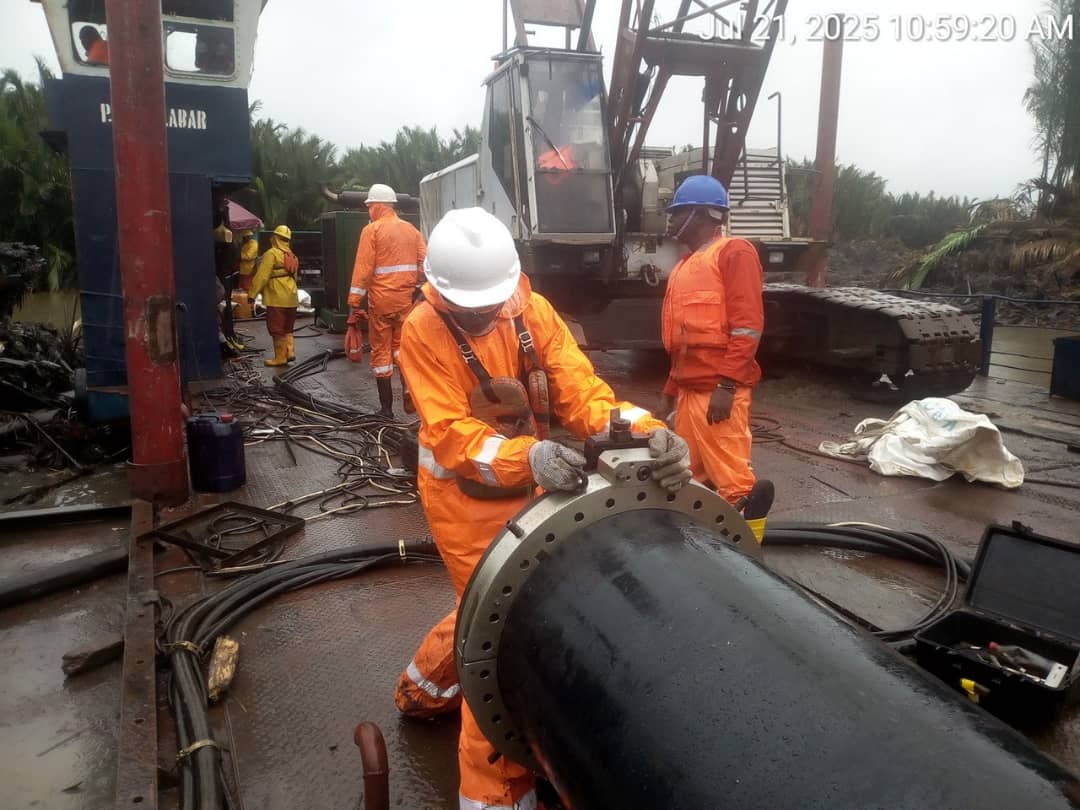
- Sectional (spool) replacement — the damaged pipe length is cut out entirely and replaced with a new pipe spool, welded in and non-destructively tested. This is the standard response to illegal-tapping damage, severe corrosion, or dents and gouges beyond clamp-repair limits — and it’s effectively the only option once a length of pipe has been physically stolen, as in the 2025–2026 theft incidents described above.
- Hot tapping and line stopping — a temporary mechanical stopper is installed inside the line on either side of the work area, isolating the section that needs repair without depressurising or shutting down the whole pipeline. This lets crews carry out sectional replacement or new valve installation on an operating line.
Because sectional replacement means new pipe, welding, coating, and hydrotesting, it costs more and takes longer than a clamp repair — but it’s the only real option once a section has been cut out, stolen, or damaged beyond what a clamp can safely hold.
Key Benefits of Pipeline Sectionalization
- Contains losses to a single, short segment instead of the full pipeline length
- Speeds up emergency response — crews isolate and depressurise a known, bounded section instead of searching an entire route
- Reduces environmental impact of spills, since less product escapes before isolation
- Enables planned maintenance on one section without a full pipeline shutdown
- Supports regulatory compliance with NUPRC/NMDPRA pipeline-integrity requirements and ASME design codes
- Protects revenue and reduces risk exposure by capping the product volume any single incident can lose
Challenges of Sectionalization in the Nigerian Context
- Cost and forex exposure — actuated valves, SCADA equipment, and specialised steel are often imported and priced in foreign currency, a real constraint given naira volatility
- Terrain — creek, swamp, and riverine crossings in the Niger Delta make installation and ongoing maintenance access genuinely difficult
- Security of the valve stations themselves — remote valve and metering stations can become targets in their own right, part of why NUPRC’s 2026 security framework leans on drone surveillance rather than physical guards alone
- Skilled-labour availability — installing and maintaining SCADA-integrated ESDVs needs instrumentation and controls expertise that isn’t evenly distributed across the country
- Balancing valve density against capital cost — more valve stations mean smaller, safer sections, but each one adds capex plus an ongoing maintenance and security burden
Choosing a Pipeline Sectionalization Contractor in Nigeria
Whether you’re an operator specifying a new valve station or a contractor bidding for the work, a credible sectionalization provider should be able to show:
- Valid registration and licensing with NUPRC and/or NMDPRA, as applicable to the pipeline segment
- NCDMB Nigerian-content certification for fabrication and installation work
- Valves and materials specified to API 6D and installed per ASME B31.4/B31.8
- A track record of completed sectionalizing-valve, hot-tap, or sectional-replacement projects at comparable pipeline diameters and pressures
- Local fabrication, spares, and after-sales support — important given import lead times on specialised valves and actuators
[Publishing this on your own company site? Swap this section for your specific certifications, project references, and a call-to-action linking to your quote-request page.]
Frequently Asked Questions
What does “pipeline sectional” mean? It’s shorthand people search for two related but different things: (1) sectionalizing valves — the block valves that divide a pipeline into isolated segments — and (2) sectional replacement — the repair technique of cutting out and replacing a damaged length of pipe. This guide covers both.
What is a sectionalizing valve? A valve installed on a pipeline’s mainline, at a planned interval, that lets operators isolate a section of the line by closing the valves on either side of it — used to limit product loss during a leak, rupture, or illegal tap.
How far apart are sectionalizing valves placed on Nigerian gas pipelines? Under ASME B31.8, spacing depends on how populated the surrounding area is — up to 30 km in sparsely populated (Class 1) areas, down to 7 km in dense urban (Class 4) areas. Liquid pipelines are placed at specific risk points, such as river crossings and tie-ins, rather than a fixed distance.
Which agencies regulate pipeline safety in Nigeria? The Nigerian Upstream Petroleum Regulatory Commission (NUPRC) and the Nigerian Midstream and Downstream Petroleum Regulatory Authority (NMDPRA), both created under the Petroleum Industry Act 2021, alongside the Nigerian Content Development and Monitoring Board (NCDMB) for local-content compliance.
Can sectionalizing valves stop pipeline vandalism completely? No single measure can. Sectionalizing valves limit how much product is lost and how much of the pipeline is affected once a breach happens; they work alongside surveillance — including the drone-based monitoring NUPRC and the Ministry of Defence began deploying in 2026 — community engagement, and physical security to reduce both the frequency and the impact of vandalism and theft.
What’s the difference between a repair clamp and sectional replacement? A clamp or sleeve fits over damaged pipe and can often go on without a shutdown, but it’s generally a temporary or semi-permanent fix. Sectional replacement removes the damaged pipe entirely and welds in a new spool — slower and more expensive, but necessary for severe damage or where pipe has been physically stolen.
Conclusion
Pipeline sectionalization sits at the intersection of engineering design, regulatory compliance, and Nigeria’s very specific security environment. Getting it right means specifying sectionalizing valves at the correct spacing under ASME B31.4/B31.8, working within the NUPRC/NMDPRA/NCDMB regulatory framework, and choosing the right repair method — clamp or full sectional replacement — when damage occurs. Done well, it’s one of the most cost-effective ways to limit how much a single act of vandalism, corrosion failure, or theft can cost an operator, a host community, or the country’s crude oil output.